Timeshare vs. Renting vs. Airbnb: What Actually Costs Less Over 10 Years
Timeshare vs. Renting vs. Airbnb: What Actually Costs Less Over 10 Years
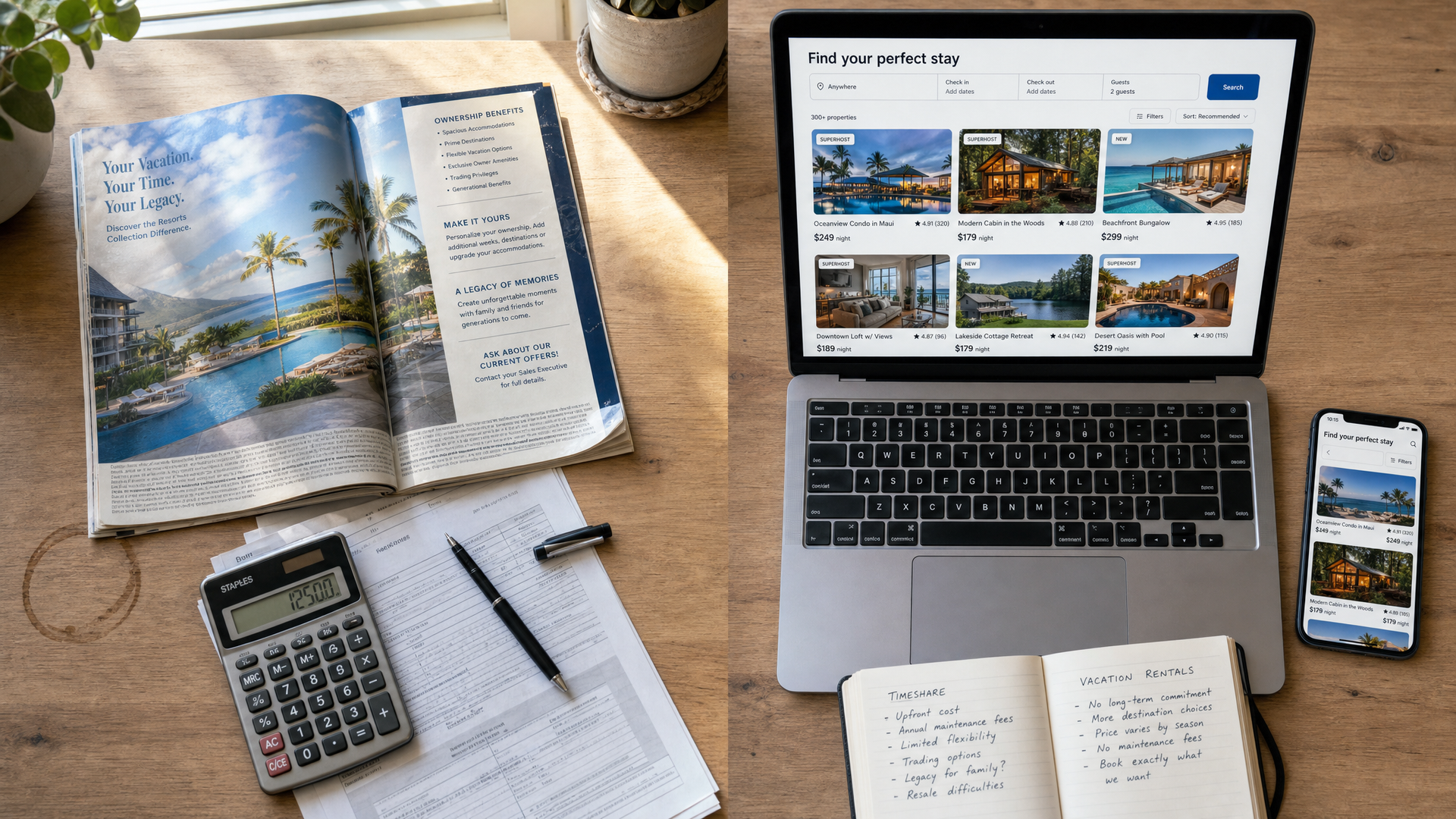
Timeshare presentations sell a simple pitch: lock in your vacation costs now, save money for decades. Run the actual numbers against the alternatives, and that pitch mostly falls apart. Here's the real math.
How Big Is the Timeshare Industry, and What Does That Scale Tell Us?
The U.S. timeshare industry now generates roughly $10.7 billion in annual sales, according to the American Resort Development Association's 2025 industry report — a business built on convincing people that prepaying for vacations beats the alternatives. That's a claim worth actually testing against the numbers, not just accepting at face value.
What Does a Typical Timeshare Actually Cost Over 10 Years?
A typical entry-level timeshare purchase runs $20,000-$40,000 upfront, plus annual maintenance fees averaging around $1,480 in 2025 and rising 5-8% a year. Over a 10-year period, that's roughly $25,000-$45,000 upfront plus an additional $17,000-$20,000 in cumulative maintenance fees — landing somewhere in the $42,000-$65,000 range for a single week of accommodations per year, before accounting for any special assessments, financing interest, or upgrade pressure along the way.
What Would the Same 10 Years of Vacationing Cost Through Renting or Airbnb?
A comparable week-long stay at a similar-quality resort destination, booked directly through a hotel or Airbnb each year, typically runs $1,500-$3,500 depending on the destination and season — landing at roughly $15,000-$35,000 over 10 years, with zero locked-in obligation, zero maintenance fees, and complete freedom to change destinations, skip a year, or adjust length of stay based on your actual life circumstances that year.
Where Does the Timeshare Math Actually Fall Apart?
Three factors specifically:
- Inflexibility has a real financial cost, not just an inconvenience cost. A timeshare locks you into a specific week, specific unit type, and often a specific resort — deviating from that requires exchange fees, points-system complexity, or accepting a lesser property.
- Maintenance fees compound in a way rental costs don't. Renting a comparable unit doesn't come with an annually escalating fee independent of what you're actually paying for lodging — timeshare maintenance fees do, and they climb whether you use the property or not.
- The exit isn't free. Deciding renting was the better call after all doesn't cost anything extra. Deciding a timeshare was the wrong call means pursuing a timeshare exit, since — as we've covered in why resale rarely works — reselling a timeshare typically returns 40-80% less than the purchase price, if it sells at all.
Are There Any Scenarios Where a Timeshare Actually Wins?
To be fair, a few circumstances tilt the math differently: a family that reliably vacations at the exact same destination every single year for decades, values the larger villa-style space over a hotel room, and never needs flexibility might extract more value from ownership than the equivalent rental cost. That's a genuinely narrow use case, though — most families' travel preferences shift meaningfully over a 10-20 year span, which is exactly the mismatch that drives so many owners toward wanting how to cancel a timeshare a few years in.
Does This Comparison Hold Across Major Developers?
Yes — the fundamental math doesn't change meaningfully whether the timeshare is with Marriott Vacation Club, Hilton Grand Vacations, Wyndham Destinations, or Diamond Resorts. Brand prestige affects the initial purchase price and perceived value, but the structural comparison against renting — upfront cost, compounding fees, inflexibility, weak resale — applies across the board.
What If You've Already Run These Numbers and Realized You Made the Wrong Call?
If you're looking at your own maintenance fee statements and realizing renting would have cost meaningfully less over the years you've owned, that realization is common, and it doesn't mean anything went uniquely wrong on your end — it means the sales pitch obscured the real math, the same way it does for most buyers. Understanding exactly what you own is the starting point for figuring out how to get out of a timeshare rather than continuing to pay into a structure that's costing more than the alternative.
Frequently Asked Questions
Is a timeshare ever actually cheaper than renting the same vacation every year?
In narrow cases — the same destination, same unit type, for 15-20+ years without change — the math can favor ownership. For most owners whose travel preferences shift over time, renting or booking through Airbnb typically costs less over a comparable period.
Why do timeshare maintenance fees rise faster than typical rental costs?
Maintenance fees fund property upkeep, staffing, insurance, and reserve funds independent of usage, and they're contractually built to increase 5-8% annually — a structural cost renting doesn't carry, since you only pay for the specific stays you actually book.
Does the comparison change if I finance the timeshare purchase?
It gets worse for the timeshare, not better — financing adds interest costs on top of the purchase price and maintenance fees, widening the gap compared to paying as you go for individual rental stays.
If the math doesn't work out, how hard is it to get out of a timeshare?
It's more complex than simply choosing not to renew a rental booking, but a structured exit process exists specifically for this — it's a different process than a resale attempt, and doesn't depend on finding a buyer.
Realized the Numbers Don't Add Up in Your Favor?
If you've done the math and your timeshare is costing more than the alternative ever would have, you have real options for moving on.
Call AxeMyTimeshare at (949) 731-6607 for a free consultation, or visit axemytimeshare.com to see what a structured exit could look like for your situation.



FBI Warns: Cartel-Linked Timeshare Exit Scams Have Stolen Nearly $300 Million From Owners Since 2019