
Timeshare Points Systems Explained: The Flexible Vacation Plan That Isn't
Timeshare Points Systems Explained: The Flexible Vacation Plan That Isn't

The pitch sounds better than it used to. No more fixed week at a single resort. No more showing up in the same condo every July whether you want to or not. Instead: a bank of points you can spend however you like — fly to Hawaii one year, ski Colorado the next, take a long weekend in Sedona whenever the mood strikes.
That's how timeshare points are sold. Here's how they actually work.
What Is a Timeshare Points System?
A timeshare points system replaces a fixed deeded week with a annual allotment of developer-issued points. Instead of owning the right to use a specific unit at a specific resort during a specific week, you own points that can theoretically be redeemed for nights at any resort in the developer's network.
The major developers have all migrated toward this model. Wyndham's Club Wyndham uses points. Marriott Vacations Worldwide's Abound program runs on points. Hilton Grand Vacations uses its ClubPoints system. Bluegreen Vacations uses a points currency. Disney Vacation Club operates on points redeemable at DVC resorts.
The shift to points wasn't primarily about flexibility for owners. It was about flexibility for developers — specifically the ability to sell the same underlying inventory multiple times, adjust redemption costs without changing the nominal "price" of points, and make the product harder to understand, compare, and exit.
How Do Timeshare Points Work in Practice?
When you buy a points-based timeshare, you're purchasing an annual allotment of points — typically somewhere between 50,000 and 300,000 depending on the brand and what you paid. Those points reset (or sometimes roll over, depending on the contract) each year and can be used to book stays at resorts in the developer's network.
The catch is that point requirements for specific stays are set entirely by the developer — and they change. A week at a desirable resort during peak season might cost 150,000 points. The same unit during an off-peak week might cost 60,000. The developer adjusts these values through what's typically called a "points chart," and most contracts give the developer the right to modify point costs over time.
This creates a structural problem for owners: you bought a certain number of points at a certain price, but the purchasing power of those points is not guaranteed. If the developer inflates point costs — and most do, gradually — your annual allotment buys less each year without any formal fee increase. The American Resort Development Association tracks industry pricing, but individual developer point charts are proprietary and not subject to public disclosure requirements.
Points are also typically subject to blackout dates, advance booking windows, and availability rules that favor higher-tier members or those booking further in advance. What was advertised as a flexible on-demand system often requires planning six to twelve months ahead for desirable destinations during desirable dates — which is essentially the same constraint as a fixed week, with more complexity layered on top.
What's the Difference Between Points and a Deeded Timeshare Week?
This distinction matters enormously — not just for understanding what you own, but for determining your exit options.
A deeded timeshare week is real property. You receive a recorded deed — typically a tenancy in common interest — in the real estate records of the county where the resort is located. You technically own a fractional interest in real property, which means the Real Property Law of that state governs your ownership. It also means a deed transfer is required to exit, which is why deed-back programs exist.
A points-based timeshare is typically a right-to-use contract, not a property interest. You're purchasing a license to use resort facilities for a defined period — often the duration of the developer's lease on the underlying property. When that lease ends (sometimes 30, 50, or 99 years out), the interest expires. There is no deed to transfer, no property interest to foreclose, and in some states, different consumer protection laws apply.
Some developers sell points that are "backed" by a deeded interest in a home resort — meaning a deed is recorded to satisfy state real estate disclosure requirements, but the owner's actual usage is governed by the points system and the developer's rules, not by the deed. This hybrid structure is common at Wyndham and Marriott properties and is intentionally opaque.
The practical implication: your contract type — deeded week, right-to-use, or hybrid — determines which exit paths are available and what legal framework applies to any dispute. Before you can build an exit strategy, you need to know what you actually own.
Why Do Timeshare Points Lose Value Over Time?
Points depreciate through two mechanisms that work simultaneously and quietly.
Mechanism 1: Point cost inflation. Developers raise the number of points required for popular stays over time. If a peak-season week at your preferred resort cost 100,000 points in 2018 and costs 140,000 in 2026, your annual allotment of 120,000 points no longer covers that stay — without any announcement, fee increase, or contract change. The developer hasn't technically broken any rule; they've simply adjusted their proprietary chart.
Mechanism 2: Currency dilution. Developers sell more points every year. More points in circulation competing for the same fixed inventory means the availability problem compounds. Popular destinations during peak weeks fill up faster, which pushes owners toward either booking less desirable options or paying for point upgrades.
This dynamic is structurally similar to how airline frequent flyer miles have devalued over the past decade — the same basic mechanism of a company controlling both the supply of points and the cost of redemptions with no external check on either. The difference is that you paid $20,000–$50,000 upfront for your timeshare points. Nobody pays a one-time purchase price for their Delta SkyMiles.
How Do Timeshare Points Affect Your Exit Options?
Points contracts are generally harder to exit than deeded weeks — for several reasons.
No deed to deed-back. If your contract is a right-to-use points contract with no recorded deed, the resort's deed-back program may not apply to you in the traditional sense. Some developers have adapted their voluntary surrender processes for points contracts, but the terms vary and the process is less standardized.
Harder to document misrepresentation. In deeded week sales, misrepresentation cases often center on specific promises about a specific unit. In points sales, the pitch is inherently vague — "flexibility," "access," "options" — which makes it harder (though not impossible) to build a case around specific false statements. That said, the Federal Trade Commission has taken action against developers whose points advertising materially misrepresented availability and redemption flexibility.
Contract terms are more complex. Points contracts tend to be longer, more internally cross-referenced, and more likely to contain arbitration clauses, class action waivers, and choice-of-law provisions that require any dispute to be resolved in the developer's home state. These provisions don't make exit impossible, but they add friction to attorney-driven cancellation efforts.
The FTC Holder Rule still applies when financing is involved. If you financed your points purchase through the developer's lending arm — which is extremely common since most buyers don't pay cash — the Holder Rule can still name the lender as a party in misrepresentation claims, just as it does for deeded week purchases. We covered this in detail in our guide on timeshare loan interest rates and your exit options.
Can You Sell or Transfer Timeshare Points?
The secondary market for timeshare points is even thinner than for deeded weeks — which is saying something.
Points contracts are typically non-transferable without developer consent, and most developers have right-of-first-refusal clauses that give them the ability to buy back the contract before any third-party transfer can be completed. In practice, they exercise this right at nominal value, which prevents any meaningful resale market from developing.
Some owners list their points allotments on platforms like RedWeek or SellMyTimeshareNow for a few hundred dollars — sometimes for free — and still don't find buyers. The combination of annual maintenance fees, restricted transferability, and depreciating point value makes the secondary market essentially nonexistent.
Anyone who contacts you claiming they have a buyer for your timeshare points and can get you fair market value is running a scam. This is one of the oldest plays in the timeshare resale fraud playbook.
What About Developer Exchange Programs Like RCI and Interval International?
Most timeshare developers are affiliated with one of two major exchange networks: RCI (owned by Wyndham Hotels & Resorts) or Interval International (owned by Marriott Vacations Worldwide).
These programs allow owners to deposit their week or points allotment into a shared pool and exchange for stays at affiliated resorts worldwide. They're sold as a feature that expands your access beyond the developer's own network.
What they don't always mention: exchange requires depositing your allotment first, which means giving up your own usage rights for that period. Exchange requests are subject to availability, which is determined by the exchange network — not you. And exchange memberships cost an additional annual fee on top of your maintenance fees.
For points owners specifically, depositing points into RCI or Interval typically converts them to the exchange network's own currency at a conversion rate controlled by the network, which further dilutes their value.
These exchange programs are not an exit strategy. They are an additional layer of complexity on top of a contract you still own and still owe fees on every year.
Frequently Asked Questions
Are timeshare points real property? Usually no. Most points-based timeshare contracts are right-to-use agreements, not property interests. Some developers record a deed to a "home resort" to satisfy state disclosure requirements, but the actual usage rights are governed by the points contract, not the deed. This distinction matters significantly for exit options.
Can timeshare points be passed to heirs? Yes, and that's part of what makes them burdensome. Most points contracts are perpetual or long-term and pass to heirs through your estate just like a deeded week would. If your heirs don't want the ongoing maintenance fee obligation, they should consult an estate attorney about refusing the inheritance in probate — ideally before the estate closes. See our guide on inherited timeshares for details.
Do timeshare points expire if unused? It depends on the contract. Some developers offer rollover provisions that allow unused points to carry forward one year. Others have "use it or lose it" structures. Rollover typically requires an additional fee, and expired points are a common complaint among owners who underutilize their allotment.
What is a "points upgrade" and should I buy one? A points upgrade is an upsell offered at owner update meetings — essentially a sales presentation disguised as a courtesy call. The pitch is that your current point level isn't sufficient for the stays you want, and buying more points will restore your flexibility. This is the timeshare industry's version of a subscription tier upgrade — and it's one of the documented tactics used to keep owners financially entangled rather than pursuing exit. We covered this dynamic in full in our Wyndham sales tactics expose.
Can I exit a points-based timeshare contract? Yes. The process is more nuanced than exiting a deeded week, but points contracts can be cancelled through third-party exit companies, attorney-driven cancellation built on misrepresentation claims, or in some cases voluntary surrender directly with the developer. The right path depends on your contract type, whether you're still financing, and your history with the developer. A free consultation is the fastest way to identify which route applies to your situation.
The Bottom Line
Timeshare points were designed to sound like an upgrade over fixed weeks — and in a marketing brochure, they are. In practice, they're a more complex, less transparent version of the same perpetual obligation: annual maintenance fees that rise every year, an asset with no resale value, and a contract that survives you.
If you own a points-based timeshare and you're frustrated by availability, rising costs, or simply want out, the first step is understanding exactly what type of contract you have. That determines everything about your exit.
Start with a free consultation — no pressure, no upfront fees →



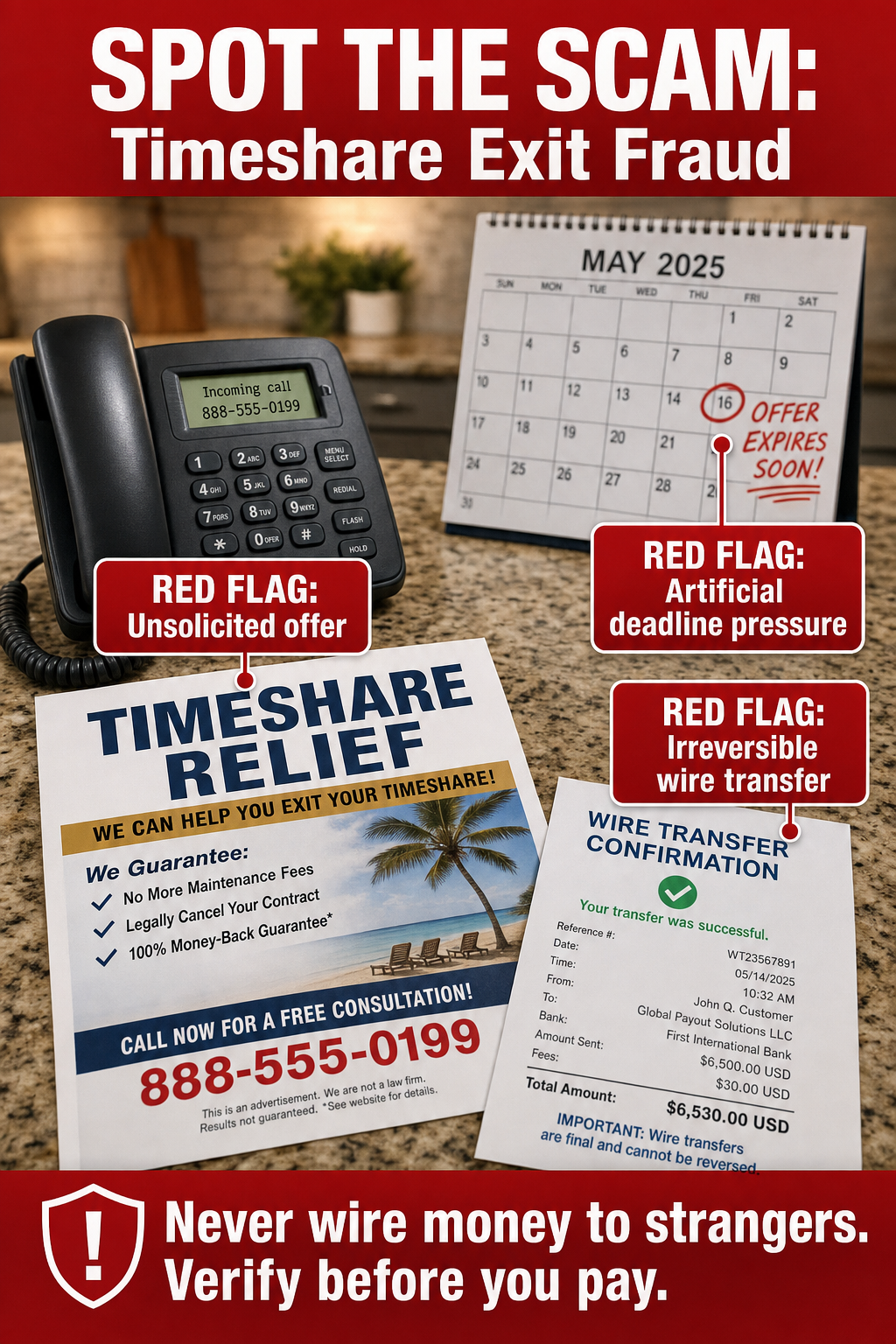
FBI Warns: Cartel-Linked Timeshare Exit Scams Have Stolen Nearly $300 Million From Owners Since 2019