Timeshare Upgrade Traps: Why "Improving" Your Membership Usually Costs You Twice
Timeshare Upgrade Traps: Why "Improving" Your Membership Usually Costs You Twice
Timeshare upgrades are pitched as improvements — more properties, better perks, lower fees. In practice, they're one of the most reliable ways developers convert an existing owner into a bigger, longer-term financial commitment. As the industry has consolidated in recent years, upgrade pitches have only gotten more frequent and more sophisticated. Here's what's actually happening behind the pitch, and how to protect yourself.
Why Does My Timeshare Company Keep Pushing an Upgrade?
If your timeshare felt like a great deal when you signed and now suddenly doesn't measure up according to your resort, that shift usually has more to do with the company's incentives than with your original contract losing value. Maintenance fees and special assessments already exist specifically to fund property upkeep — that's their entire purpose. An upgrade pitch reframing your existing membership as outdated or insufficient is typically a sales strategy to lock you into a new, more expensive membership tier, not a reflection of any real decline in your current contract.
How Big Is the Timeshare Industry Behind These Upgrade Pitches?
Upgrade campaigns aren't isolated efforts by individual sales reps — they're organized initiatives run by an industry that generates roughly $10.7 billion in annual U.S. sales and serves nearly 10 million owner households, according to the American Resort Development Association's 2025 industry report. That scale means upgrade outreach is typically planned, tested, and refined at a corporate level — not improvised — which is exactly why owners need a correspondingly deliberate approach when evaluating whether an offer is genuinely worth it.
How Do Corporate Mergers Create New Upgrade Pressure?
Developers frequently use corporate mergers and new membership tiers as fresh upgrade opportunities, and the pace of consolidation has accelerated. The clearest recent example: after Hilton Grand Vacations acquired Diamond Resorts in August 2021, the combined company launched HGV Max, a new membership tier granting access to both the Diamond and Hilton Grand Vacations resort portfolios. Hilton Grand Vacations later acquired Bluegreen Vacations in January 2024 as well, folding a third major portfolio into the same upgrade-eligible ecosystem. Similarly, Marriott Vacations Worldwide acquired Welk Resorts in January 2021, and Travel + Leisure Co. (formerly Wyndham Destinations) acquired Accor Vacation Club in March 2024 — both mergers followed by waves of upgrade outreach to legacy owners on each side of the deal.
On paper, expanded destination access sounds like a genuine improvement. In practice, it illustrates exactly how these upgrades tend to work: the pitch emphasizes the wider destination selection while downplaying — or omitting entirely — that the arrangement can leave an owner responsible for two full sets of maintenance fees rather than one, roughly doubling the annual financial commitment for access that may never actually be used to its full potential.
What's the "Equity Discount" Trick, and Why Doesn't It Work the Way It's Pitched?
Developers often present an upgrade using language about "equity" in your current timeshare — implying the value you've already paid into your existing contract can be applied as a credit toward a new, "superior" membership. It's a compelling frame, but it typically doesn't hold up under scrutiny: the so-called equity discount frequently results in owners paying significantly more for the upgrade than the incremental benefits actually justify. This is the same underlying dynamic we've broken down in detail using an economist's actual profitability formula for timeshares — the advertised value and the real, math-backed value are often two very different numbers.
A related version of this pitch promises the upgrade will lower your annual maintenance fees. In most cases, that promise doesn't materialize either — owners remain responsible for the fees tied to their original timeshare and take on new fees for the upgraded property, doubling their financial commitment rather than reducing it.
What Should You Look For in an Upgrade Contract Before Signing Anything?
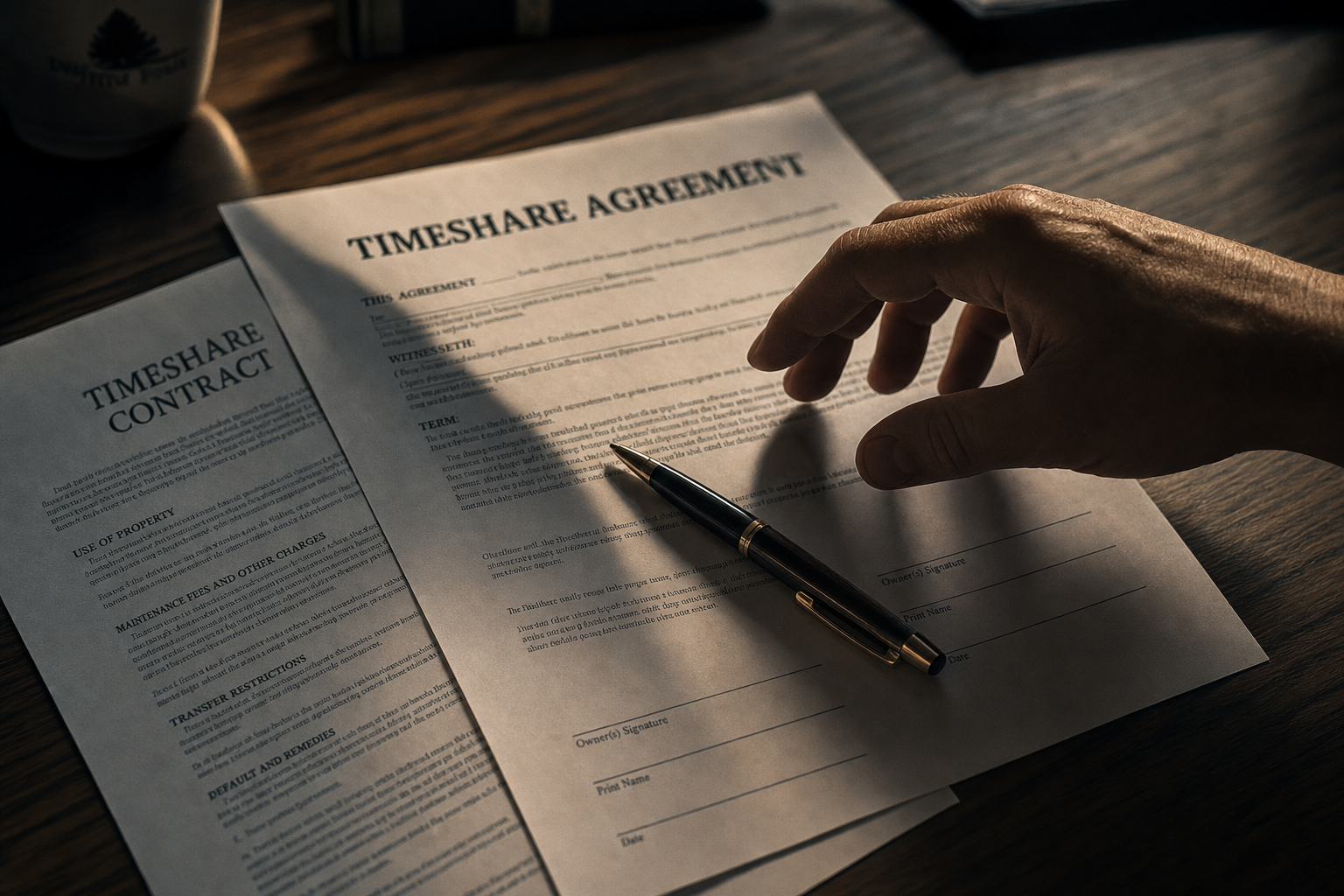
The single most important thing to verify in any upgrade contract is whether it explicitly states that your original timeshare is being relinquished and replaced. A genuine upgrade should read as a clean swap — old contract terminated, new contract in its place. A few specific checks worth running before signing:
Look for explicit relinquishment language. The contract should state clearly that your original timeshare interest is being surrendered as part of the transaction.
Get total combined annual costs in writing. Ask for the full maintenance fee, dues, and assessment total across both the old and new agreements — not just the marketed "new" fee.
Confirm your rescission window applies to the upgrade too. Many states treat an upgrade as a new purchase, which means a fresh cooling-off period may apply — verify this explicitly rather than assuming your original purchase's window has any bearing.
Request an independent breakdown of "equity" value. If a rep can't produce a written calculation showing exactly how equity was determined, treat the number as a sales estimate, not a verified figure.
If relinquishment language is missing or unclear, that's a serious red flag: its absence typically means you're not upgrading at all, but rather taking on a second timeshare in addition to the one you already have, with the corresponding doubled membership and maintenance fee obligations.
Does This Pattern Show Up Across Other Major Developers Too?
Yes — HGV Max is the clearest recent illustration because of the scale of the Hilton–Diamond–Bluegreen consolidation, but the same upgrade-pitch structure appears across Marriott Vacation Club, Wyndham Destinations, and Bluegreen Vacations as well, particularly following any merger, tier restructuring, or "loyalty program enhancement" announcement. Any time a developer restructures its membership system, existing owners should expect a wave of upgrade outreach — and should evaluate each offer independently rather than assuming loyalty or tenure with the brand makes the pitch more trustworthy.
What If You've Already Signed an Upgrade You Regret?
If you agreed to an upgrade and later discovered you're now paying two sets of fees instead of one — or that the promised savings never materialized — you're dealing with exactly the pattern described above, and you're not alone in it. Understanding what you actually own now across both the original and upgraded contracts is the necessary first step before pursuing a Hilton Grand Vacations timeshare exit, a Wyndham timeshare cancellation, or a Marriott timeshare exit — since an upgrade situation often means untangling two contracts instead of one.
Frequently Asked Questions
Do timeshare upgrades ever actually lower my maintenance fees?
Rarely. Most upgrade offers that promise lower fees still leave owners responsible for the original timeshare's maintenance costs on top of the new membership's fees, effectively doubling the financial obligation instead of reducing it.
What is HGV Max, and does it apply to all Hilton Grand Vacations owners?
HGV Max is a membership tier created after Hilton Grand Vacations acquired Diamond Resorts, offering access to both companies' resort portfolios. It's an upgrade option, not an automatic or required change to existing Hilton Grand Vacations or Diamond Resorts contracts.
How can I tell if an upgrade contract is a true replacement or a second timeshare?
Check specifically for language stating your original timeshare is being relinquished or terminated as part of the new agreement. If that language is missing, you may be taking on an additional timeshare rather than replacing your existing one.
Is "equity" in a timeshare a real financial asset I can leverage?
Not in the way traditional real estate equity works. Timeshares generally don't appreciate, and equity-discount language in upgrade pitches is typically a sales framing device rather than a reflection of real, transferable asset value.
Does a timeshare upgrade come with its own cancellation window?
Often, yes — many states treat an upgrade as a new purchase subject to its own rescission period, separate from any rights tied to your original contract. Confirm this explicitly rather than assuming your original purchase's window applies.
Why have upgrade offers become more common in recent years?
Rapid industry consolidation — including Hilton Grand Vacations' acquisitions of Diamond Resorts and Bluegreen Vacations, and Marriott's and Travel + Leisure's respective acquisitions of Welk Resorts and Accor Vacation Club — has created large combined portfolios that developers actively market as upgrade opportunities to legacy owners on both sides of each merger.
Stuck With a Timeshare Upgrade That Doubled Your Fees?
Whether it's an HGV Max upgrade, a Marriott points restructure, or a Wyndham membership tier change that left you paying for two contracts instead of one, you don't have to untangle it alone.
Call AxeMyTimeshare at (949) 731-6607 for a free consultation, or visit axemytimeshare.com to see what a structured exit could look like for your situation.



FBI Warns: Cartel-Linked Timeshare Exit Scams Have Stolen Nearly $300 Million From Owners Since 2019