
Timeshare Resale Scams: How They Work, Who's Running Them, and How to Actually Get Out
Timeshare Resale Scams: How They Work, Who's Running Them, and How to Actually Get Out

You've been paying maintenance fees for years. The vacation no longer excites you. So you go online, find a company promising to sell your timeshare for a fair price — and you hand over $2,000 upfront. Weeks pass. The company stops returning calls. The money is gone.
This is the timeshare resale scam. It's one of the most reported consumer fraud schemes in the United States, and it happens tens of thousands of times every year. The Federal Trade Commission, the American Resort Development Association, and state attorneys general across the country have all issued warnings about it — and yet the operations keep spinning up, keep targeting the same exhausted owners, and keep disappearing with the fees.
If you've already been hit, you're not alone and you're not naive. These are professional operations. If you're researching before making a move, this post will show you exactly how they work — and what options actually exist for getting out of your timeshare legally.
How Do Timeshare Resale Scams Actually Work?
The structure is almost always the same. A company — often calling itself a "timeshare resale broker," "licensed resale agent," or "vacation property marketplace" — contacts you by phone, email, or online ad. They claim to have a buyer lined up, or a strong market for your specific resort. Sometimes they reference real resorts: Wyndham, Marriott Vacation Club, Hilton Grand Vacations, Bluegreen, Diamond Resorts. The specificity is intentional — it makes the pitch feel credible.
They then ask for an upfront fee. This is framed as a "listing fee," "transfer fee," "closing cost," "title search," or "escrow deposit." It ranges from a few hundred dollars to several thousand. You pay it. The sale never happens. The company either disappears or invents reasons to ask for more money before the "closing" can proceed.
The FTC has documented this pattern extensively. In its guidance on timeshare resale fraud, the agency notes that legitimate real estate brokers do not collect upfront fees before a sale closes — commissions come out of proceeds. Any company asking for money before delivering a result is operating outside normal industry practice.
What Are the Warning Signs of a Timeshare Resale Scam?
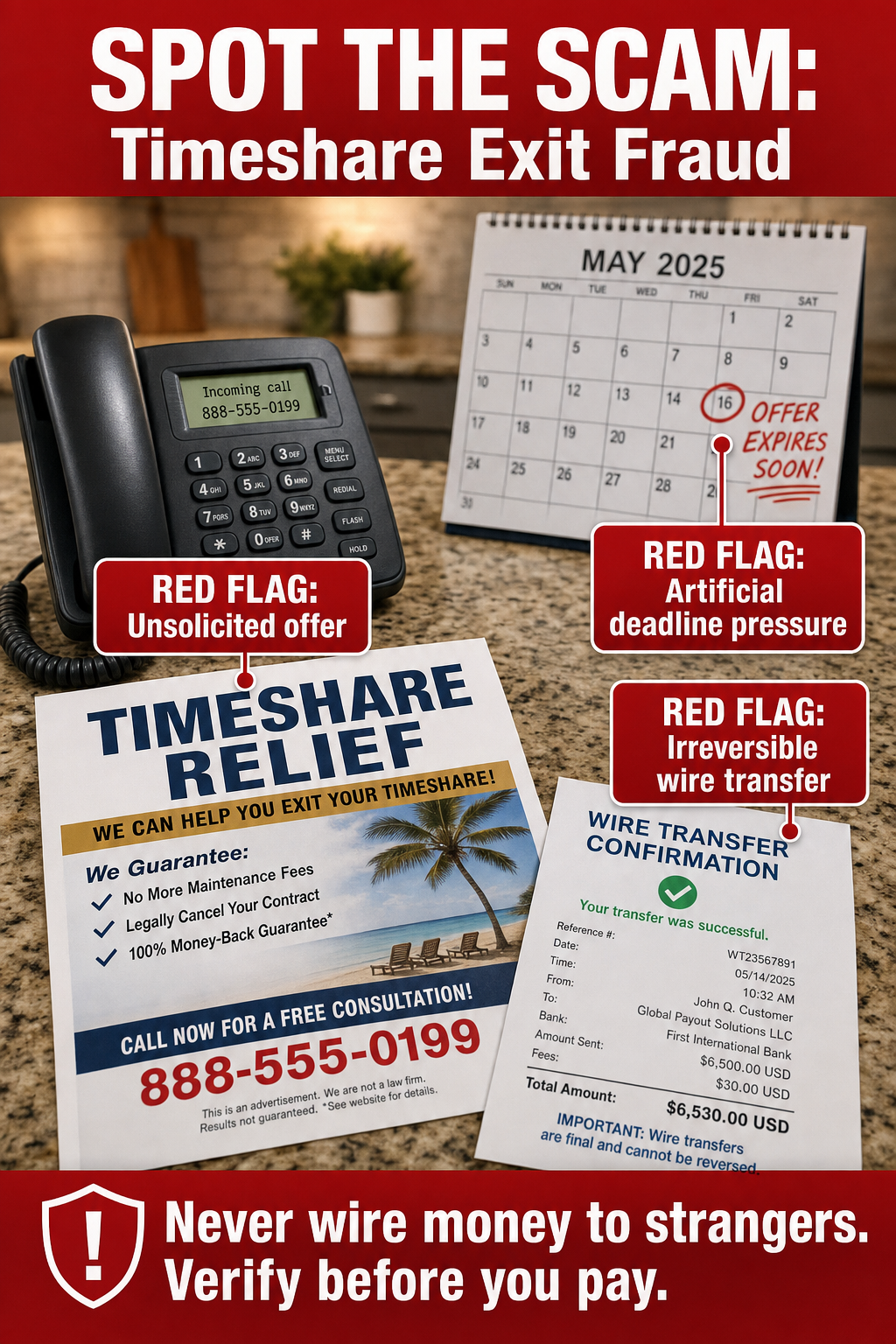
They contacted you first. Legitimate brokers don't cold-call owners with buyers already lined up. If someone reached out to you unsolicited claiming to have a buyer for your specific unit, that's the primary red flag.
They want money before anything is delivered. No legitimate licensed real estate professional collects a fee before the transaction closes. "Listing fees," "administrative deposits," and "transfer processing fees" collected upfront are the mechanism of the scam — not the cost of doing business.
They use pressure tactics. Urgency language — "the buyer is ready to move this week," "prices are dropping, now is the time" — is a classic fraud signal. The Consumer Financial Protection Bureau and state attorneys general have flagged this language in enforcement actions against timeshare resale operations.
They're not licensed. Real estate transactions require a licensed broker in the state where the property is located. Ask for their license number, then verify it with the state's real estate regulatory commission. Many of these operations cannot produce one.
They guarantee a sale price. No honest broker guarantees resale value on a timeshare. The secondary market for timeshares is notoriously weak — many units sell for $1 on eBay or can't be given away. A guaranteed price is a fiction used to justify the upfront fee.
Why Is the Timeshare Resale Market So Difficult?
This is worth understanding, because it explains why the scams work. Timeshare resale fraud succeeds in part because owners genuinely want to believe a market exists. But the economics of timeshare resale are deeply unfavorable.
The American Resort Development Association estimates there are millions of timeshare units in the United States, concentrated in resort states including Florida, Nevada, Hawaii, and California. Supply vastly outpaces demand on the secondary market. Major platforms like eBay, Craigslist, and the Timeshare Users Group regularly list timeshares for $1 — and many still don't sell.
The reason is structural. A timeshare isn't property in the traditional sense — it's a right to use. The buyer doesn't inherit a sellable asset; they inherit the maintenance fees, special assessments, and legal obligations. For most properties, the ongoing annual cost makes the acquisition unattractive regardless of price.
Scammers exploit the gap between what owners hope their timeshare is worth and what it will actually trade for. The promise of a real buyer at a real price is exactly what desperate owners want to hear.
What Happens After You Pay the Upfront Fee?
Most victims report the same sequence. After the initial payment, there is a brief period of apparent activity — emails, reference numbers, supposed buyer communications. Then the delays start. A title issue. A buyer financing contingency. A regulatory hold. Each delay comes with a request for another fee.
This is called "reload fraud." The FBI has tracked reload fraud as a follow-on to timeshare resale scams specifically: once a victim has paid once, they are often re-targeted by the same operation or by affiliated groups who buy victim lists. Some owners lose $10,000, $20,000, or more across multiple scam operations targeting them sequentially.
Recovering the money is difficult. Most of these operations route payments through wire transfers or prepaid cards, which are hard to reverse. If you paid by credit card, you may have a chargeback option — contact your issuer immediately. Report the fraud to the FTC at ReportFraud.ftc.gov and to your state attorney general's consumer protection office.
Is There a Legitimate Way to Sell a Timeshare?
There are legitimate resale channels, though managing expectations is critical.
The Timeshare Users Group (TUG) is a long-standing owner forum where timeshares are listed without upfront fees. RedWeek.com also offers listing services. Licensed real estate brokers who specialize in timeshare resale do exist — verify licensure before engaging.
However, for the majority of timeshare owners, the realistic resale price is far below what was paid, and in many cases the unit cannot be sold at all. If your goal is simply to stop paying maintenance fees and exit the obligation permanently, resale is often not the path — because there's no buyer.
What Are the Legal Alternatives to Resale?
If resale isn't viable — and for most owners it isn't — there are options that actually work.
Rescission. If you're within the rescission window (typically 3–10 days depending on state law), you can cancel your timeshare contract without penalty. Florida gives 10 days. California gives 3. Nevada gives 5. If you're inside this window, act immediately — contact the resort in writing.
Deed-in-Lieu. Some resort developers — including Wyndham and Hilton Grand Vacations — have formal deedback or deed-in-lieu programs that allow owners to return the timeshare directly to the resort. Eligibility requirements vary. You'll typically need to be current on fees, have no mortgage balance, and sometimes pay a processing fee. These programs are real but not widely advertised.
Timeshare Exit Companies. A legitimate timeshare exit company works with attorneys to legally terminate your ownership contract — not sell it. The process typically involves negotiating with the resort, analyzing the contract for legal deficiencies, and executing a transfer or cancellation. Unlike resale brokers, reputable exit companies don't promise buyers — they promise exits.
The distinction matters. If a company says they'll "sell" your timeshare, that's the resale model. If they say they'll legally terminate your ownership, that's the exit model. The outcomes and processes are entirely different. Learn more about how timeshare cancellation actually works.
Foreclosure. Stopping payments and allowing the resort to foreclose is technically an exit — but it comes with credit consequences and potential liability for remaining balances. It's generally a last resort, and not a strategy to pursue without understanding the full implications for your credit profile.
How Do You Find a Legitimate Timeshare Exit Company?
The timeshare exit industry has had its own fraud problems, so due diligence matters here too.
Look for companies that work with licensed attorneys, are transparent about the process and timeline, don't charge fees for a "free consultation," and have verifiable track records. Check the Better Business Bureau. Search the company name alongside the word "complaint" or "review" before committing.
Be cautious of exit companies that mirror the language of resale scams — guarantees, urgency, vague fee structures. A legitimate exit process takes months, not weeks, and a reputable company will tell you that upfront. See how our process works and our track record before deciding.
Frequently Asked Questions
Can the FTC help me get my money back from a timeshare resale scam? The FTC investigates and pursues enforcement actions against timeshare fraud operations, but individual restitution is not guaranteed. Filing a report at ReportFraud.ftc.gov contributes to investigations and may help if the agency reaches a settlement with the company. Your strongest immediate option is a credit card chargeback if you paid that way.
Is it legal to charge upfront fees for timeshare resale? In many states, charging upfront fees for timeshare resale services is illegal or heavily regulated. Florida's Timeshare Resale Accountability Act, passed in 2012, specifically regulates upfront fee practices for timeshare resale companies operating in that state. Other states have similar consumer protection statutes. An upfront fee demand is both a fraud signal and potentially a legal violation.
What's the difference between a timeshare resale scam and a timeshare exit scam? A resale scam promises to find a buyer for your timeshare, collects a fee, and delivers nothing. An exit scam may promise legal cancellation but similarly collects fees without performing the work. Both exist. The key due diligence is the same: verify licensing, check the BBB, confirm the company works with licensed attorneys, and avoid any operation demanding large upfront payments with no verifiable track record.
Can I just walk away from my timeshare? Walking away — stopping payments — is not a clean exit. The resort can pursue collections, report the delinquency to credit bureaus, and in some cases pursue a deficiency judgment depending on your contract and state law. It is not the same as a legal timeshare exit, and the credit and financial consequences can follow you for years.
How long does a legitimate timeshare exit take? Depending on the resort, contract type, and exit method, legitimate timeshare exits typically take 6 to 18 months. Operations claiming to exit timeshares in weeks are either cutting corners or misrepresenting the process.
Axe My Timeshare connects owners with a vetted exit process — no resale promises, no upfront scams, no vague timelines. If you're ready to stop paying for something you don't want, start with a free confidential consultation.



FBI Warns: Cartel-Linked Timeshare Exit Scams Have Stolen Nearly $300 Million From Owners Since 2019