Timeshare Rescission Period: How to Cancel Before It's Too Late
Timeshare Rescission Period: How to Cancel Before It's Too Late
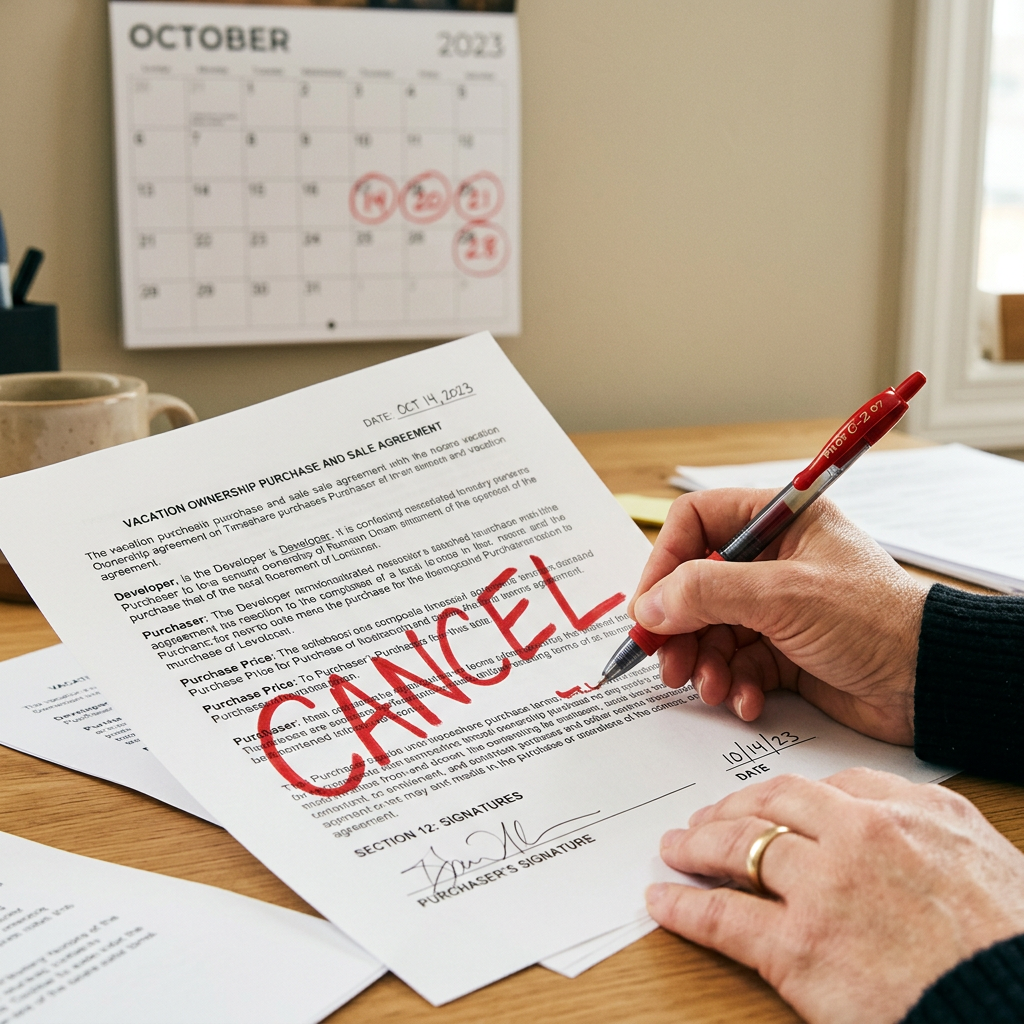
If you just bought a timeshare and you're already having second thoughts, stop what you're doing and read this first.
Every state in the U.S. gives timeshare buyers a window of time to cancel their purchase — no questions asked, no penalty, no need to explain yourself. It's called the rescission period, and it is the single most powerful consumer protection available to timeshare owners.
It is also time-limited. In some states, you have three days. In others, fifteen. Once that window closes, you lose the right entirely — and the exit options that remain are far more expensive, more complicated, and not guaranteed.
Here's exactly how it works, what the deadlines are by state, and how to execute a rescission correctly so the resort can't reject it.
What Is a Timeshare Rescission Period?
The rescission period — sometimes called the "cooling off period" or "cancellation period" — is a legally mandated window during which a timeshare buyer can cancel their contract and receive a full refund of any deposit or down payment made at the time of purchase.
It exists because timeshare sales presentations are, by design, high-pressure environments. The Federal Trade Commission has long recognized that purchases made under sales pressure — particularly large purchases made after four to six hour presentations — deserve a cooling-off period during which buyers can reconsider without financial consequence. State timeshare statutes codify this right, and every U.S. state that regulates timeshare sales includes some form of rescission window.
The rescission right is absolute within the window. The resort cannot charge a cancellation fee. They cannot withhold a portion of your deposit. They cannot make rescission conditional on attending another presentation or speaking with a "customer service" representative. If you submit a valid written cancellation within the statutory window, they are legally obligated to refund your money.
How Long Is the Timeshare Rescission Period by State?
Rescission periods vary by state because timeshare regulation is primarily state-level, not federal. The resort's location — not your home state — determines which law applies.
Here are the rescission windows for the states with the highest concentration of timeshare resorts:
Florida — 10 days. Under Florida Statute § 721.10, buyers have ten calendar days from the date of the purchase contract or receipt of the public offering statement, whichever is later. Florida is home to more timeshare resorts than any other state, and the ten-day window is one of the more generous in the country.
Nevada — 5 days. Under Nevada Revised Statutes § 119A.410, buyers have five calendar days from contract execution or receipt of the public offering statement.
California — 3 business days. Under California Business and Professions Code § 11239, buyers have three business days from contract signing. Note that "business days" excludes weekends and holidays — making this one of the tightest windows in the country.
South Carolina — 5 days. Under the South Carolina Vacation Time Sharing Act, buyers have five calendar days from contract signing.
Tennessee — 10 days. Under Tennessee's timeshare statute, buyers have ten days from signing or receipt of the public offering statement.
Arizona — 7 days. Arizona's timeshare law provides seven calendar days from contract execution.
Missouri — 5 days. Missouri's timeshare statute provides five calendar days from signing.
Hawaii — 7 days. Under Hawaii's timeshare law, buyers have seven calendar days from contract execution.
Virginia — 7 days. Virginia's timeshare statute provides a seven-day cancellation right from the date of the contract.
Colorado — 5 days. Colorado's timeshare act provides five business days from signing.
If your resort is in a state not listed here, check the public offering statement you received at signing — it is legally required to disclose the applicable rescission period. If you don't have it, call the resort and ask; they are required to provide it.
When Does the Rescission Clock Start?
This is where many buyers make a critical mistake: assuming the clock starts when they get home and look at the contract again.
In most states, the rescission clock starts on the date of contract signing — not the date you receive documents in the mail, not the date you return from vacation, and not the date you first have regrets. A few states tie the start to the date you receive the public offering statement, which can sometimes be a day or two after signing — but don't count on that extension without confirming your specific state's statute.
The practical implication: if you signed on Saturday at a resort in Orlando, your ten-day Florida window started on Saturday. You have until the tenth calendar day after that date to submit your cancellation. Do not wait until you get home to decide. Do not wait until you've talked to your financial advisor. Start the process immediately.
How Do You Submit a Valid Timeshare Rescission?
Execution matters as much as timing. A rescission letter that arrives after the deadline, uses the wrong address, or is missing required information can be — and sometimes is — rejected by the resort. Here is exactly how to do it correctly.
Step 1: Write a cancellation letter. Your letter does not need to be long or legally sophisticated. It needs to clearly state: your full name as it appears on the contract, the contract number or purchase date, the resort name, and an unambiguous statement that you are exercising your right to rescind the timeshare purchase contract. Do not apologize, do not explain your reasons, and do not negotiate. A simple, direct statement is sufficient and harder to challenge.
Step 2: Send it to the correct address. Your public offering statement or contract should specify the address for rescission notices. Use that exact address. Do not send it to the resort's front desk, your salesperson's email, or the general customer service line. Many rescission rejections happen because the letter was sent to the wrong location.
Step 3: Send via certified mail with return receipt. Every state that provides a rescission right allows delivery by certified mail. Send your letter via USPS certified mail and request a return receipt (green card). This gives you a timestamped, signed proof of delivery that is extremely difficult for the resort to dispute. Keep the receipt permanently.
Step 4: Send copies by multiple methods. In addition to certified mail, consider sending the same letter by overnight courier (FedEx or UPS) for belt-and-suspenders proof, and emailing a copy to every address you have for the developer — salesperson, customer service, and any address listed in the contract. Note: email alone may not satisfy the statutory requirement in all states, so certified mail is non-negotiable.
Step 5: Follow up in writing. After submitting, send a follow-up communication asking for written confirmation that your rescission has been received and processed. Keep records of every interaction.
What Happens After You Submit a Rescission?
Once a valid rescission is received within the statutory window, the resort is legally required to process your cancellation and return your deposit or down payment within a set timeframe — typically 20 to 45 days depending on state law.
If the resort attempts to charge a fee, disputes the validity of your rescission, or does not return your money within the statutory timeframe, you have recourse. Contact your state attorney general's consumer protection division — the Florida Attorney General, Nevada Attorney General, or equivalent in the resort's state — and file a complaint. You can also file a complaint with the Consumer Financial Protection Bureau if a loan was involved.
If you paid by credit card, contact your card issuer to initiate a chargeback under Regulation Z of the Truth in Lending Act. A disputed charge combined with documented rescission notice is a strong chargeback case.
Do not let the resort tell you that your rescission is "under review," that they need additional documentation, or that you need to come in for a meeting. These are delay tactics. Your cancellation right is statutory — it does not require the resort's agreement or cooperation to be valid.
What If You Missed the Rescission Window?
If your rescission period has already closed, you cannot recover it. The window is a hard deadline, and no amount of regret, financial hardship, or subsequent discovery of problems with the presentation reopens it once it passes.
That said, missing rescission is not the end of the road — it's the beginning of a more complex process.
Owners outside the rescission window still have legal exit options. These include developer-run voluntary surrender programs like the Wyndham Ovation Program or Marriott's Abound Exit path (covered in detail in our guide on timeshare deed-back programs), third-party exit companies that pursue contract cancellation through misrepresentation claims, and attorney-driven cancellation under state Unfair and Deceptive Acts and Practices statutes.
The earlier you act after missing rescission, the more leverage you have. Evidence of what was said during the sales presentation fades, witnesses move on, and some legal claims have statutes of limitation. If you've just missed your window by days or weeks, consult with an exit specialist immediately — don't wait.
For owners who are years past their rescission window, the path is longer but exits do happen. We've seen contracts cancelled across all the major brands — Wyndham, Marriott, Bluegreen, Hilton Grand Vacations, and others. The key is identifying which exit route fits your specific contract, financing situation, and history with the developer.
Does Rescission Apply to Timeshare Upgrades and Add-Ons?
Yes — with important nuances.
If you attended an "owner update" meeting and were sold additional points, a new contract tier, or a product upgrade while on a resort vacation, that transaction is typically treated as a new purchase under most state timeshare statutes. You should have received a new rescission disclosure at that signing.
This matters because many owners who feel trapped in their original contract don't realize that a more recent upgrade purchase may still be within its rescission window — or may have had one that was never properly disclosed. Failure to provide a proper rescission disclosure is itself a violation of most state timeshare statutes and can form the basis of a cancellation claim even outside the standard window.
If you signed any timeshare-related documents in the past two weeks — original purchase, upgrade, add-on, or modification — check your paperwork immediately and assume time is running out until you confirm otherwise.
Frequently Asked Questions
Does the rescission period apply to timeshare resales purchased from another owner? Generally no. Rescission rights under state timeshare statutes typically apply to purchases made directly from licensed timeshare developers. Private resale transactions — where one owner sells to another — are usually governed by standard real estate or contract law, which does not carry an automatic cooling-off period.
Can the resort extend my rescission period? No. The rescission period is set by state statute and cannot be shortened by the developer. Some states allow developers to offer a longer period voluntarily, but no developer can shorten the statutory minimum. If a salesperson told you that you had five days and the statute provides ten, the statute controls.
What if I signed the contract in one state but live in another? The law of the state where the resort is located typically governs your timeshare contract, not the law of your home state. Your public offering statement should specify the applicable law. If in doubt, look at where the resort is physically located.
Can I rescind a timeshare by phone or email? Most state statutes require written notice. Phone calls do not satisfy the rescission requirement, and email alone may not be sufficient in all states. Certified mail to the address specified in your contract is the safest and most defensible method. Always follow up any other communication with certified mail.
Do I need a lawyer to submit a rescission? No. The rescission right is a statutory consumer protection and does not require an attorney to exercise. You can write and send the cancellation letter yourself. An attorney can help if the resort disputes your rescission or refuses to refund your deposit — but for the submission itself, a clear written letter sent on time is all you need.
The Bottom Line
The rescission period is the cleanest, cheapest, and most legally airtight exit available to timeshare buyers — and it disappears within days of signing. If you're in that window right now, use it. Write the letter today, send it certified mail tonight, and keep every record.
If you've already missed it, you still have options — but the path gets harder and longer the more time passes.
Not sure where you stand? Get a free consultation — no pressure, no upfront fees →