
Timeshare Cancellation: How It Actually Works (And What to Expect in 2026)
Timeshare Cancellation: How It Actually Works (And What to Expect in 2026)

The short answer: Timeshare cancellation is the formal legal process of permanently terminating your timeshare contract and ending all future maintenance fee obligations. It's different from rescission (which only works in the first 3–15 days after signing) and different from resale (which transfers the contract to someone else). True cancellation eliminates the contract entirely — once it's done, you owe nothing, the resort has no claim against you, and your name is removed from the deed. The process typically takes 6–18 months and costs between $3,000 and $10,000 when handled by a licensed exit company working with attorneys.
If you've been paying maintenance fees for years on a timeshare you don't use, can't book, or were pressured into buying, cancellation is what you're actually looking for — not resale, not "transferring" the contract to a stranger, and not just walking away. Here's exactly how it works.
What Is Timeshare Cancellation?
Timeshare cancellation is the permanent legal termination of a timeshare contract. After a successful cancellation, three things are true:
- The contract is voided — there's no document obligating you to anything
- Your name is removed from the deed (for deeded timeshares) or the membership records (for points-based contracts)
- The annual maintenance fees stop forever — and so do the special assessments
That's the goal. Cancellation isn't a payment plan. It isn't a hardship deferral. It isn't the developer "letting you skip a year." It's the contract going away.
Three things cancellation is not:
- Not rescission. Rescission is a 3–15-day window after signing where any buyer can back out for any reason. If you signed years ago, rescission is off the table.
- Not resale. Resale transfers the contract to a new owner. The contract still exists — somebody else just pays the fees. The secondary market is so flooded that most timeshares sell for $1 on eBay, and many won't sell at all.
- Not foreclosure or walk-away. Walking away ends your payments but damages your credit and exposes you to collection lawsuits. Cancellation protects your credit because the contract is formally terminated, not breached.
Why Cancellation Matters More in 2026 Than It Did Five Years Ago
The math has gotten worse. According to the American Resort Development Association's 2025 industry report, the average annual maintenance fee hit $1,480 per weekly interval in 2024 — a 17.5% single-year increase, and a 33% jump since 2020 when fees averaged $1,120. Industry estimates put the 2026 average at roughly $1,610. That's nearly 60% above the rate of overall inflation during the same period.
Finn Law Group's analysis projects the average owner will pay around $44,484 in maintenance fees alone over a 20-year ownership period — before special assessments, before exchange company fees, before any of the "vacation" costs that timeshares were marketed as eliminating.
For owners who bought 10+ years ago at a $700–$900 annual fee, the cancellation conversation isn't theoretical anymore. It's the difference between a manageable retirement and a recurring six-figure liability passed to your kids through inheritance clauses written into the contract.
The 5-Step Timeshare Cancellation Process
Every legitimate cancellation follows roughly the same arc, regardless of which exit company or attorney handles it.
Step 1: Contract Review and Eligibility Assessment
A licensed exit company or attorney reviews your contract, sales materials, and ownership documents to identify the legal pathway most likely to succeed. They're looking for:
- The state the contract was signed in (different states have different consumer protection laws)
- Whether the contract is deeded real estate or right-to-use (RTU)
- Whether you still owe on the original loan (this changes everything about the strategy)
- Evidence of misrepresentation during the sales presentation
- Current account status (paid up vs. delinquent)
This step typically happens during the free consultation. Any company that quotes you a price before reviewing the contract is guessing — and probably overcharging.
Step 2: Strategy Selection
Based on the review, one of three primary strategies is selected:
- Developer surrender path: Used when the contract is fully paid off, fees are current, and the resort has an active deed-back program. Cheapest, fastest, but only available to a subset of owners.
- Negotiated cancellation: The exit company or attorney negotiates directly with the developer's legal team to terminate the contract. Used when the developer has rejected the owner from its internal program or when the contract has complications.
- Legal cancellation based on misrepresentation: Used when the sales presentation included material false statements about value, fees, rental income, or contract terms. This is the slowest path but often the most effective for owners who were aggressively pressured at the original sales presentation.
Step 3: Service Agreement and Escrow
You sign a service agreement with the exit company that spells out:
- The specific exit strategy being used
- The total fee and the payment schedule (almost always financed in installments)
- The written guarantee — what happens if the cancellation doesn't go through
- The expected timeline
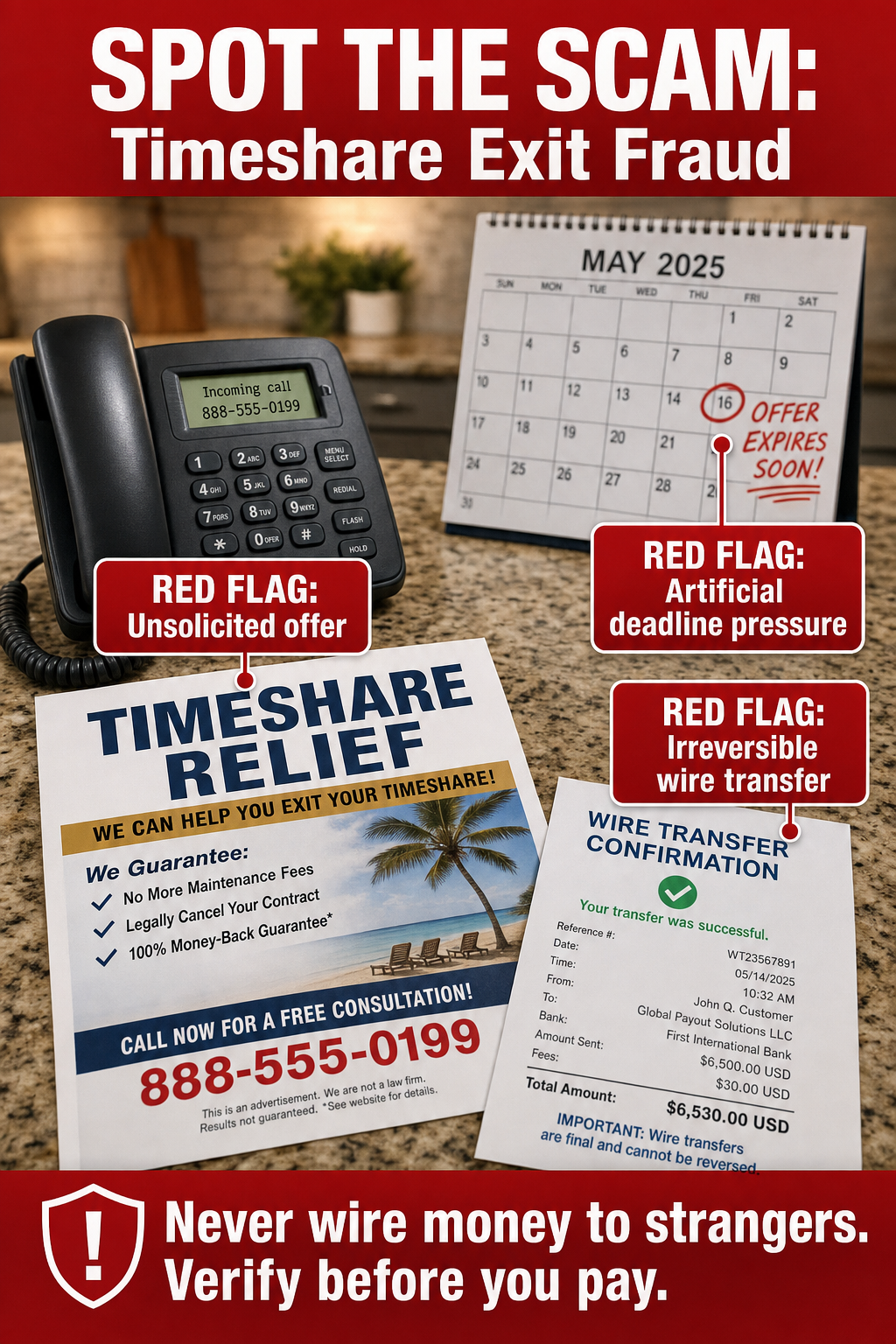
Critical: Legitimate exit companies never demand the full fee upfront. Payments are typically structured through escrow or held until milestones are met. If a company wants $8,000 wired today before they start, walk away — that's a textbook scam pattern.
Step 4: Execution
This is the longest phase — typically 6 to 18 months. During execution:
- Legal correspondence is sent to the developer
- The owner's communication with the resort is rerouted through the exit company or attorney (you stop taking the calls)
- For deeded timeshares: a deed transfer is prepared and recorded with the county
- For points contracts: membership termination documents are drafted and executed
- For misrepresentation cases: a demand letter and supporting documentation are submitted to the developer's legal team
During this phase, you keep paying your maintenance fees unless your exit company specifically advises you to stop in writing. Stopping payments mid-exit gives the developer grounds to reject the negotiation and damages your credit.
Step 5: Confirmation and Records Update
Once the cancellation is finalized, you receive written confirmation that the contract has been terminated. For deeded timeshares, the new deed (transferring ownership away from you) is recorded at the county recorder's office. You should also receive:
- A final accounting showing zero balance owed
- Confirmation that your name has been removed from the resort's owner database
- Documentation that can be used to dispute any future billing attempts
Keep these documents permanently. A small percentage of resorts will attempt to re-bill cancelled owners years later, and the paperwork from this step is what protects you.
How Long Does Cancellation Take?
Cancellation pathwayTypical timelineRescission (within signing window)7–30 daysDeveloper deed-back / surrender60–120 daysNegotiated cancellation6–12 monthsLegal cancellation (misrepresentation)12–24 monthsCancellation with attached loan12–24 months
Anyone promising cancellation in 30 days outside of the rescission window is either selling you a worthless template letter or running a scam. The legal process of cancelling a contract recorded with a county deed office takes time — there's no way around it.
What Does Timeshare Cancellation Cost?
Costs vary based on contract complexity, but typical ranges:
- Rescission (within window): $0
- Developer surrender programs: $0 to $500 administrative fee
- Single deeded week, paid off, no complications: $3,000–$5,000
- Points-based contract or multiple weeks: $5,000–$8,000
- Contract with attached loan or misrepresentation case: $7,000–$10,000+
What drives the price up: outstanding loan balance, multiple owners on the deed (divorce situations, inherited timeshares), complex points conversions, and resorts with aggressive legal departments (Westgate, Diamond/Hilton Vacation Club).
What should never happen: full payment demanded before work begins, "extra fees" tacked on after signing, or pressure to add additional services. A real service agreement quotes one number and holds to it.
The Cancellation Scam Patterns to Watch For
The exit industry has been a target of state attorneys general and the FTC for over a decade — for good reason. The most common scam patterns:
The "buyer waiting" call. Someone calls claiming they have a buyer ready to purchase your timeshare and just need a "transfer fee" to close the deal. There is no buyer. The fee is the scam.
The "free template letter" service. Ads claiming to cancel your timeshare in 5 minutes online by sending the resort a generic template. Developers receive thousands of these and reject them all. Real cancellation requires deed work, legal correspondence, and county recording — not a form letter.
The "lifetime guarantee" pitch. A guarantee is only as good as the company offering it. Many exit companies operating under "lifetime guarantee" branding have shut down and reopened under new names multiple times. Look for companies with verifiable business history, BBB profiles, and licensed attorneys on staff.
Upfront full payment. No legitimate cancellation service collects $5,000–$10,000 upfront before doing any work. Payment plans, escrow, or milestone-based payments are standard.
Cold outreach. If a company contacted you first — by phone, email, or text — out of the blue, that's almost always a scam. Reputable exit companies grow through referrals and inbound consultation requests, not cold calls to scraped owner lists.
Is Timeshare Cancellation Right for You?
Cancellation makes sense if:
- You're past the rescission window (almost everyone is)
- Your developer has rejected you from its internal program, or you don't qualify
- You can't sell the contract on the resale market
- You don't want to damage your credit with a strategic walk-away
- You're tired of fee increases and special assessments with no end in sight
- You want to protect your heirs from inheriting the contract
If you fit any combination of those, the next step is a free consultation to figure out which cancellation pathway fits your specific contract.
Get a free, no-pressure consultation →
Frequently Asked Questions
What's the difference between timeshare cancellation and timeshare rescission? Rescission is a 3–15-day window after signing where any buyer can back out for any reason at no cost. Cancellation is the legal process of terminating a contract that's already past the rescission window — it requires legal work, takes 6–18 months, and costs $3,000–$10,000 depending on contract complexity.
Can I cancel my timeshare contract on my own without an exit company? Inside the rescission window, yes — you just send a certified mail cancellation letter. Outside the rescission window, cancellation requires deed work, legal correspondence with the developer's attorneys, and (for misrepresentation cases) formal legal action. Most owners hire an exit company or attorney because the developer's legal team will not engage seriously with an unrepresented owner.
Will timeshare cancellation hurt my credit? A properly executed legal cancellation does not damage your credit. The contract is terminated through deed transfer, settlement, or legal cancellation — not foreclosure. Credit damage occurs when owners stop paying fees without a formal exit strategy and get reported to credit bureaus for delinquency. The cancellation process specifically avoids that outcome.
How much does timeshare cancellation cost in 2026? Most legitimate cancellations cost $3,000 to $10,000, structured as a payment plan over the duration of the exit process. The exact price depends on contract type, outstanding loan balance, number of weeks or points owned, and whether legal action is required to compel the developer to release the contract.
Can I cancel a timeshare if I still owe money on the loan? Yes, but the developer's free deed-back programs will not accept it. You'll need either to pay the loan off first or work with an exit company that handles loan-attached contracts through legal cancellation. Loan-attached cases are more complex and typically cost more, but they are not impossible.
Does cancellation work for Wyndham, Marriott, and Hilton timeshares? Yes — these three developers represent the majority of cancellation cases handled by the exit industry. Wyndham's Ovation program, Marriott's Authorized Resale, and Hilton's deed-back programs are starting points, but acceptance is not guaranteed. Owners rejected by these internal programs commonly proceed to negotiated or legal cancellation.
What happens to my heirs if I cancel before I die? Cancellation removes the contract entirely, which means there's nothing left to inherit. This is one of the most common reasons owners pursue cancellation in their 60s and 70s — to prevent the perpetuity clause in the contract from passing the maintenance fee obligation to their children or estate.
How do I know if a cancellation company is legitimate? Verify the BBB profile, look for licensed attorneys on staff (not just "consultants"), confirm the written guarantee is in the service agreement, check that they don't demand full payment upfront, and make sure they didn't cold-call you first. Reputable companies grow through referrals and inbound consultations — not cold outreach.
The Bottom Line
Timeshare cancellation is the only path that permanently ends both the contract and the fees. It's slower than walking away, more expensive than waiting for the developer's free deed-back program, and more involved than listing on the resale market — but it's the only option that actually solves the problem for owners outside the rescission window.
If you've been paying fees for years on a contract you'd cancel today if you could, that's the conversation worth having. See how the process works, why we built Axe My Timeshare, and what owners say after exiting Wyndham, Marriott, Bluegreen, and Westgate contracts.
Get your free consultation → or call (949) 731-6607 to talk to a real person.



FBI Warns: Cartel-Linked Timeshare Exit Scams Have Stolen Nearly $300 Million From Owners Since 2019